
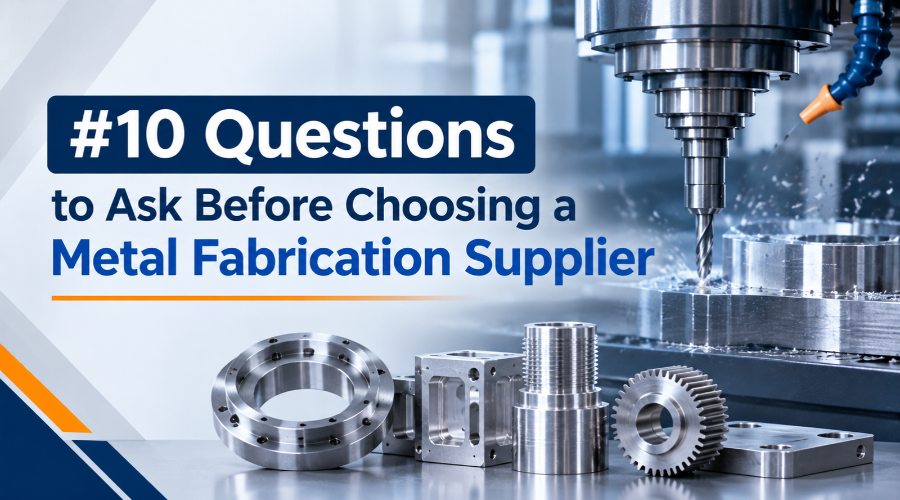
A bad fabrication supplier does not fail on the first day. Parts arrive a little off, then a little late, then a lot off. By then, you've paid for the tooling, and the line waits. The following 10 questions pick up most problems before you sign. They are organized within capabilities, quality, design support, and commercial terms. Use them in your first contact with all short-listed suppliers.
A custom fabricated sheet metal parts supplier cuts, bends, welds, and finishes metal sheet to your drawings. Parts range from brackets to full enclosures. Typically, thickness is 0.5 to 25 mm, depending on the process.
Capability indicates whether the factory can produce your part. Question 1: Which processes are kept in-house? A full-service supplier should be able to cut, bend, weld, and finish on site. The basic ones are laser cutting, CNC press brake bending, punching, TIG and MIG welding, and powder coating. Each and every outsourced step equals days and quality loss.
Question 2: What materials and thicknesses can they work with? Usual stock includes cold-rolled steel (SPCC), galvanized steel, 304 stainless and 316 stainless, and 5052 aluminum. The carbon steel cutting capacity is approximately 20mm on the 6kW fiber lasers and 25mm on the 12kW fiber lasers. Ask about the maximum sheet size as well. Standard sheets are 1,250 × 2,500 mm.
Question 3: What tolerances can they hold? Normally, laser cutting is ±0.1 mm, while bending is done with a press brake at ±0.5° angles and ±0.2 mm flange length. For welded assemblies, this is more often ±0.5mm. Ask what the normal tolerance level is. ISO 2768-m is common. Narrower limits are more expensive; use them only when necessary.
Quality questions indicate a supplier's approach to failure. Question 4: What is their certification? ISO 9001:2015 is the baseline. Automotive assembly requires IATF 16949. Structural welds could require EN 1090 or ISO 3834. Obtain the certificate number and expiry date, and confirm it with the certificate body.
Question 5: How do they inspect parts? Consider calipers, height gauges, and a coordinate measuring machine (CMM) that has an accuracy of approximately 2 to 3 microns. Request a first article inspection report with all dimensions noted on a drawing of your own. When production runs, refer to the sampling plan. AQL 1.0 for major defects is a reasonable request.
Question 6: Can they trace materials? A good supplier will retain mill test certificates for each lot of sheets per EN 10204 3.1. Each batch must include a traceable lot number that can be traced to the raw material. Traceability is important in a recall. A supplier without a certificate within 1 day is a risk; price accordingly.
Question 7 is about design support. Good suppliers will review drawings and flag expensive features before quoting. This consists of standard recommendations for bend radius, hole-to-edge spacing, or relief cuts, which can save up to 10% to 20% of unit cost.
The service life of the part is determined by its completion. Inquire about the supplier's in-house finishes. Enclosures are usually powder-coated in the 60-120 micron range. Zinc plating is used for fasteners and brackets. Anodizing protects aluminum. The ASTM B117 salt spray test is a reasonable goal for outdoor parts.
If their supplier does a good job, then Assembly adds value. The fabricator can perform hardware fitting, wire harness mounting, and light installation during PEM insertion. This reduces freight legs and damage from handling. Verify that painted surfaces are protected by packaging. Foam, kraft interlacing, and corner guards are inexpensive to help avoid scratches.
Commercial terms decide what the relationship feels like in month six. Question 8: What are the MOQ and lead times? Some fabricators take single-piece prototype orders and offer 5- to 10-day lead times. Typically requires 15 to 30 days for production. Request feedback on their rush rates and request the surcharge rate.
Question 9: How is the price constructed? Quotes include clear details of material, cutting, bending, welding, finishing, packing, and tooling. Material can contribute up to 50% to 30% of the cost. Inquire about supplier metal price updates and a metal price lock for 3 to 6 months. Many hidden setup fees contribute to the surprise.
Question 10: Whom will you talk to, and who can vouch for them? Request a project manager by name and a response time of less than 24 hours. Ask for two customer references in your line of business. An honest supplier will readily give you reference contacts: they have satisfied clients. One who skips the question probably does not.
Place all quotes in one table that includes material, tolerance, finish, lead time, and tooling. Use the real volume to compare unit prices. See what each quote excludes.
Some indicators appear early on. If a supplier quotes without looking at your drawing, is unable to provide the name of its inspection equipment, or offers tolerances that are likely too good, caution is in order. When prices are lower than the competition, it means the material is often light or that they have not done some finishing touches. If the supplier rejects the sample run, it is a form of deception as well.
Walk around the shop floor, if possible. Check up on part storage, housekeeping, and machine age. Remember, clear, labeled racks signal control. Unmarked parts do not fit in. If it is not possible to visit, request a virtual visit and request the previous external inspection report.
A custom-fabricated sheet metal parts manufacturer should show you the paperwork you need to feel good about these answers, no promises. Check in sequence: ability, standard system, commercial. Try it on a small sample, read the first posting, and measure the delivery time.
Prices will vary by material, size, and finish. Simple brackets start around USD 0.50 per piece at volume, and enclosures start at USD 20+.
Choose a supplier that carries standard catalog parts as well as customer orders that are specific to drawings.
Generally, the thin-sheet fiber laser cutting machine is within ±0.1 mm, and the thickness plate cutting is within ±0.2 mm.
A bad fabrication supplier does not fail on the first day. Parts arrive a little
READ FULLIndustrial experts know how to differentiate between grades no matter
READ FULLHighlights • The bracket's grade and coating
READ FULL

Have a question or need a quote? Fill out this form and our team will get back to you quickly!


