
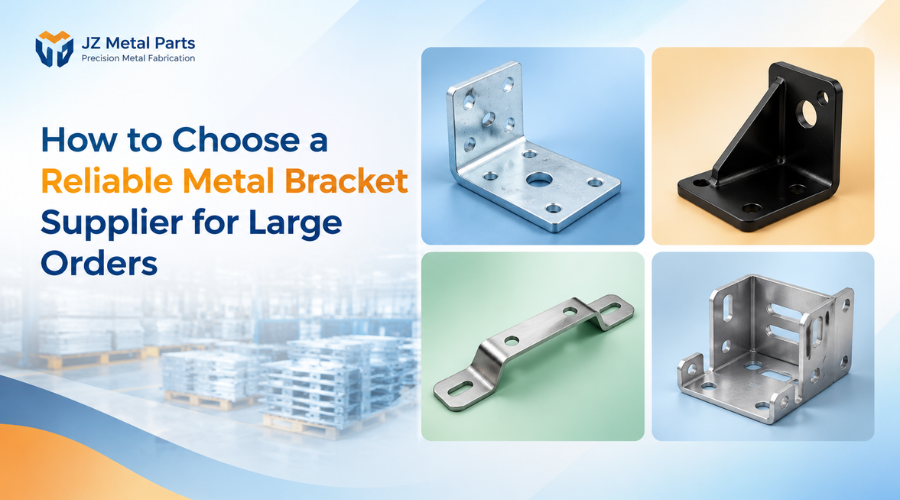
• The bracket's grade and coating determine its durability.
• Tolerance data and load ratings should be in writing.
• Real factories, not traders, are identified by ISO 9001 and mill test reports.
• First article samples detect a lot of issues before mass production.
• Tool ownership and lead time are part of the contract.
A bracket is a small part. It carries a big job: solar Racks, Shelving, HVAC Units, Furniture Frames, and Machinery Guards. If any one of these fails, the setbacks are not likely to be insignificant. This is why choosing a metal brackets exporter to place a large order goes beyond price ultimately. A poor supplier can ruin a production run. This guide details what to check and in what order, which will ease the burden for you.
Make an initial spec before you reach out to anyone. The following core terms include the term list drawing: material, thickness, finish, tolerance, quantities, target price. A general question will be answered with a general answer. You read and weigh the options and then pick the better deal priced at the lower offer. Add the use case. There is a difference between a bracket that can hold a 5Kg shelf and a solar panel rail of 200Kg. State the load, environment, and service life. Good suppliers will resist bad designs. That’s a good sign. Bad ones just say yes.
Steel is typically the preferred material. The cold-rolled carbon steel, like SPCC or Q235, is suitable for indoor use. It’s cheap and easy to form. The 304 stainless steel is moisture resistant. Grade 316 is salt-air resistant and chemically resistant. Aluminum 6061 is lighter, more corrosion-resistant, and more expensive per kilogram than aluminum 2218. Avoid a nickname and ask for an actual grade. The word "stainless" can imply anything. Ask for mill test documentation of each batch. These are the actual chemical composition and tensile strength. If it is not available, then the supplier was probably forced to purchase scrap grades and hoped you would not inquire.
Request an ISO 9001 quality certificate, mill test reports, and inspection records for past orders. Verify the certificate number by contacting the certifying authority. Order a sample next, and take your own measurements.
Typically, the thickness of a bracket is between 1.5 mm and 6 mm, and up to 10 mm wide for heavy-duty use. The minor 0.2 mm is a very small loss. It can decrease load capacity by more than 10 percent on a thin bracket. State a tolerance and deal with the supplier accordingly. The tolerance of laser cutting is within ±0.1 mm, and the tolerance of stamping and bending is ±0.1 and ±0.5 degrees, respectively. If the bracket is used for loading, ask for a load test report. You can't get it better than a real number in newtons. The more in-house testing equipment its supplier has, the more value.
When choosing brackets, the primary determinant is where they will reside. Indoor parts are protected by a zinc plating, generally 5-8 microns. For outdoor applications, 45 microns or more of hot-dip galvanizing is required. Powder coating is a durable layer of color, typically 60–100 microns thick. Anodizing works on aluminum. Ask for salt spray test results. The usual waiting time for white rust on zinc-plated parts is 48 - 96 hours. The hot-dip galvanized parts can be passed through hundreds of hours. Make sure you match the test hours with your environment. If selling to Europe, also confirm compliance with RoHS. There are some cheap platers who still utilize limited materials.
Observe the factory property. Stamping presses from 25 to 300 tons. Laser cutters. CNC bending machines. Welding robots. Tooling shops. The factory quickly repairs dies in its own tool room. A shop that outsources toolmaking relies on others. For large orders, capacity is important. Request reports of output on a regular basis. A medium-size plant could produce 200,000 to 500,000 small brackets per month. Inquire about the number of other customers who have that capacity. If 80 percent of the line is taken by your order, then you're in a good position. If it's 2 percent, you'll have to wait.
Custom brackets require dies! Simple parts can cost $500 to $5,000 or more to order, depending on the design. Progressive dies can cost more. Agree in writing who owns the tooling and where it’s stored. Otherwise, you may be unable to move production later.
You must have ISO 9001:2015 as a foundation for quality management. ISO 14001 demonstrates environmental controls. Ask about IATF 16949 if your brackets go into cars. If construction activity is required, inquire about CE marking or local building standards as appropriate. Not all orders require all certificates. But the supplier should know which to apply. Also see the scope of the certificate. A certificate from a trading office does not apply to the factory where your parts are produced. The address and product scope should correspond to the plant to be purchased. Many buyers make this mistake.
The prices for brackets are calculated based on the material weight, process steps, finish, and quantity. Simple stamped steel brackets can be as little as $0.15 per unit at volume, up to $1.00 per unit. Laser-cut and bent stainless brackets will be $1.50 to $8.00. Heavy welded assemblies are more expensive. Ask for tiered quotes at 1,000, 5,000, and 20,000 pieces. The MOQ for customized parts generally starts at 500 to 2,000 pieces. Stock designs are allowed to be lower. Usually, the payment is 30 percent upfront and 70 percent upon delivery. Watch out for anyone asking for all of the money in advance. Compare not just the factory gate price but also the costs of packing, freight, and duty to be paid.
Always take the sample. Request a first article inspection report using actual measurements with your drawing. Take at least five measurements with calipers or submit them to a laboratory. Inspect hole position, bend, flatness, burrs, and coating thickness. For the main order, set an acceptance standard. AQL 1.0 for critical dimensions and AQL 2.5 for cosmetic issues is common. A third-party inspector from SGS or Intertek costs about $300-$700 for the first visit. That's low-cost insurance for phenomenally expensive orders. Check before the goods get delivered, not after they arrive.
Find out who owns the factory, how many workers produce the goods there, and whom they have sold to. Weak suppliers avoid facing such challenges. Strong ones do not have to be pushed to send photos, videos, and references.
Brackets easily scratch and rapidly rust in humid holds. Ask how they pack. VCI paper, poly bags, inner cartons, and palletized outer cartons with strapping are good choices. Loose bulk packing in sacks allows dents and rust to occur. Specify packing in the purchase order. For the first custom order, the lead time is usually 3-6 weeks plus tooling. Repeat orders ship in 2 to 4 weeks. An additional 4-6 weeks will be required for sea freight to Europe or North America. Build a buffer. Inquire about penalties for late orders and inquire about the supplier's track record of addressing delays in the past. Their answer says a lot.
When it comes to metal brackets, a reputable exporter will back it up with documentation, samples, and straight answers. Before signing, make sure to look at the material grade, certificates, tolerances, and tooling terms. Test the 1st article. Inspect before shipping. However, the price can be important, but a low bracket that arrives late is expensive in comparison.
What is a bulk metal brackets exporter for distributors and retailers?
There are certified factories that have ISO 9001 certification, and they have their own stamping factory; processing bulk orders is often 1000-5000 pieces per order.
What is the wholesale price of metal brackets?
They are priced from $0.15 to $8.00 each, and the price varies based on material, thickness, finish, and quantity.
What is a metal brackets exporter with a drawing-based production system?
There are many manufacturers that make to your drawing, and the MOQ is 500-2,000 pieces; the tooling cost is quoted separately.
Where can I get bulk metal bracket customization at reduced prices?
A number of exporters will discount custom orders by 5 to 15 percent when they have orders over 10,000 pieces, particularly repeat orders.
How long does production take for custom metal brackets?
Standard delivery time for first orders is 3-6 weeks (subject to tooling). Repeat orders are shipped 2 to 4 weeks later.
Highlights • The bracket's grade and coating
READ FULLSummary Every enclosure, bracket, panel, rib, and
READ FULLA vague RFQ produces a vague quote. If you send a
READ FULL

Have a question or need a quote? Fill out this form and our team will get back to you quickly!


