
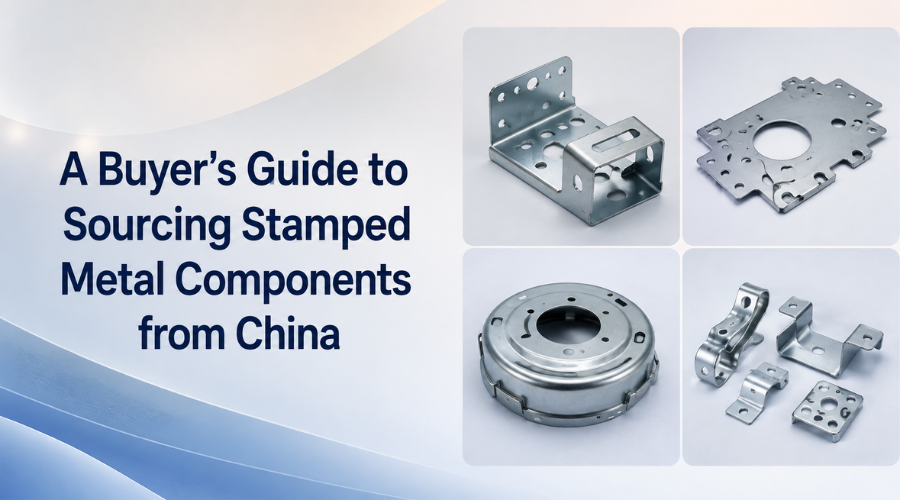
China remains one of the largest suppliers of stamped metal products. Buyers should familiarize themselves with the process and materials involved before ordering in bulk. Here's what you need to know when sourcing a custom stamped metal part from China manufacturers who can produce them truly at scale.
Metal stamping presses flat sheets of metal into certain shapes or forms with the use of dies. It involves cutting, bending, punching, and embossing and may be performed in the same production run. This process is used if thousands or millions of parts with closely matched dimensions are being produced. Buyers use stamped metal components throughout the automotive, electronics, appliance, and industrial components and equipment industries for brackets, enclosures, connectors, and structures.
Steel and Stainless Steel
Cold-rolled steel can be used for general-purpose stamping products with good strength and cost. Stainless steel provides added corrosion resistance, which is good for products in outdoor use or in wet environments. Mainly used stainless grades are 304 and 316, and 316 has more resistance in marine or chemical environments.
Aluminum
Aluminum stamping covers the use cases that require less weight without compromising on strength. The most popular alloys are 5052 and 6061, each offering improved strength and formability.
Copper and Brass
Both copper and brass are used for stamping for such applications as electrical and decorative uses due to their high conductivity and corrosion-resistance properties. When purchasing electrical connectors or electrical terminals, it is common to question buyers about the material being used for its conductive properties.
Progressive Die Stamping
Progressive die stamping is similar to die stamping, but instead of completing a single process, it involves several processes carried out in a single press stroke. This approach is suitable for high-volume production because it significantly reduces cycle time per piece.
Deep Draw Stamping
Deep draw stamping is a series of draw operations that create cup-like, deeper metal parts by combining multiple operations. This is ideal for parts like enclosures, housings, or containers that need extra depth when compared to stamping.
Transfer Die Stamping
Use mechanical transfer equipment to move the stamping die parts from one station to another instead of on a transfer belt. A suitable process for larger, more complex parts that cannot fit conveniently into a progressive die set-up process.
Tolerance and Precision Standards
In a standard case, the tolerances of the custom stamped metal components China manufacturers are between +0.05 mm and +0.1 mm. They can sometimes achieve tighter tolerances, as low as 0.02mm, but this usually requires more expensive tooling and longer production time. Confirm part tolerances with your manufacturer to ensure they meet their normal ability. If you specify tighter tolerances than you need for your application, you may be ordering unnecessarily expensive parts.
Plating and Coating Types
Common finishes are anodizing for aluminum, zinc plating, nickel plating, or powder coating. They vary in corrosion resistance, appearance, and cost. Before ordering, specify the finish that best suits the part's end-use environment.
Deburring and Edge Treatment
Deburring is frequently required to eliminate sharp edges that are a byproduct of the stamping operation. If the manufacturer does not have a standard deburring method, ask about their deburring method, and note that it may cause finish variation that could affect assembly and safety.
Tooling Cost and Ownership
Custom stamped parts are tooling intensive, meaning you must invest in dedicated tooling in addition to the part cost. Ask whether they buy the tooling with the purchase or whether it can be freely exchanged with another manufacturer without paying for tool development.
Tooling Lead Time
Custom stamped metal parts China factories usually require 20 to 40 days for tooling development, depending on the complexity of the parts being stamped. Simple flat stampings take less time to develop than complex progressive die tooling for multi-part stampings.
Minimum Order Quantities
Minimum order quantities (MOs) differ greatly for stamped metal parts and will depend on the tooling investment and the complexity of the part. Standard parts made with standard tooling can start at a couple thousand per part. More complex custom parts will likely demand a higher economic minimum of tens of thousands of pieces to be produced to run a dedicated tooling investment.
Before placing an order, ask your manufacturer if they can offer a production minimum for test runs at a higher unit cost.
In-Process Inspection
Ask about the manufacturer's quality assurance process during manufacturing, not just at shipment. This means that when you catch dimensional drift or die wear, an entire batch will not be shipped with similar defects.
First Article Inspection
Ask for an initial report on the first articles before production. You're getting this report to confirm that the first set of sample parts meets the tolerances and size you specified.
Third-Party Testing
For critical applications, consider requesting third-party material certification or dimensional testing. This is an added expense, but it also gives an outside inspection other than what the manufacturer performs.
Factory Audits
Before placing a big order, request a factory audit report, either through a visit or a third-party provider. This audit verifies that manufacturing capacity, equipment, and quality control systems match what the manufacturer describes.
Communication and Technical Support
Keep it technical at this early stage of sourcing; ask questions such as tolerance capability or specific material grade availability. Suppliers with concrete, precise responses have more disciplined manufacturing operations than suppliers who offer reassurances with no specifics.
Export Experience
Ensure the manufacturer has experience delivering to your country and with the required documents and product certifications. Paperwork requirements are usually easier to estimate for a manufacturer with export experience than for one new to exporting.
ISO 9001 Certification
A manufacturer with ISO 9001 certification has a documented quality management system that it maintains. It's a broader application in the manufacturing sector and indicates good process control, but it does not mean perfection is achieved with every order.
Industry-Specific Certifications
Other certifications may apply depending on the application. IATF 16949 certification is occasionally needed for automotive parts. Additional compliance documents may be required for parts for particular regulated industries. Verify which certifications are relevant to your product classification before finalizing a supplier.
Material Price Fluctuation
Metal commodity prices are dynamic and change frequently, impacting the quoted price over time. Ask whether your supplier will quote a fixed price for a specific contract or if prices will fluctuate with material market moves.
Shipping and Incoterms
Check the conditions of your quote, e.g., FOB, CIF or EXW. This is the point where the responsibilities for arranging the freight costs, insurance, and customs duty are passed. For first-time importers, it's especially crucial to explain these conditions upfront to prevent any unexpected expenses at the destination port.
Preventing Corrosion During Shipping
Surface rust can form on the stamped steel part during long sea freight (LSF) transport, particularly across humid areas. Before shipment, check with your manufacturer if they use rust-preventive oil or vapor corrosion inhibitor packing. This protection is most important when the part is not yet finished or plated after it has been received.
Packing Methods for Different Part Types
Small stamped components very often ship in cartons with divider trays to minimize parts scratching during shipping. The bigger parts or delicate parts may require custom crating or individual foam packaging to prevent damage due to stacking pressure within a box.
Ask your supplier about the packaging method based on part size and finish sensitivity. If a supplier has a clear, documented packaging standard, there will likely be fewer transit damage claims than with a supplier that improvises packaging per order.
Purchasing the parts before asking their stamping manufacturer about their suitability for stamping to find out when tooling is already underway and they need changes. Not performing a first article inspection to help speed up the process can lead to entire production runs being examined too late to find dimensional problems efficiently. If buyers then do not allow sufficient lead time for their products, underestimating the tooling timeline can once again result in delays.
After finding a reliable manufacturer for customized stamped metal parts in China, we can clearly understand the value of quality and communication for future orders. When you work with a manufacturer that has prior experience with your part specifications, it's easier to get a repeat job done right.
Check and re-evaluate your relationship with your supplier every now and again as material costs and production capacity change. An annual review helps ensure you keep competitive terms as your order volume increases.
When researching custom stamped metal parts manufacturers in China, focus on tolerance capability, tooling terms, and quality control measures. Ask for and verify the factory audits, first article inspections, and documentation before placing a bulk order. This care delivers safety to your product quality and also your manufacturing schedule.
What are some of the best places to get stamped metal parts online in bulk?
You can find a trustworthy supplier through major trade platforms or by contacting a proven metal stamping factory.
How to select the relevant supplier for stamped metal components?
Conduct factory audits, first article checks, and material certifications prior to committing to a bulk order.
What are alternatives to getting custom stamped metal parts for my company?
Coordinate with a manufacturer who is open about their tooling conditions, tolerance capability information, and export experience.
What is the lowest order value of custom stamped metal parts?
MOQs also vary by tooling complexity, from a few thousand to much more for complex custom tooling.
What is the time to get tools developed for custom stamped parts?
It normally takes 20 to 40 days to develop tooling that fits the requirements of the part and the die.
Aluminum enclosures protect electronics, control systems, and industrial equipment. It's
READ FULLChina remains one of the largest suppliers of stamped metal products. Buyers should fami
READ FULLAluminum enclosures are the most basic foundation of almost every tech or electric devic
READ FULL

Have a question or need a quote? Fill out this form and our team will get back to you quickly!


