
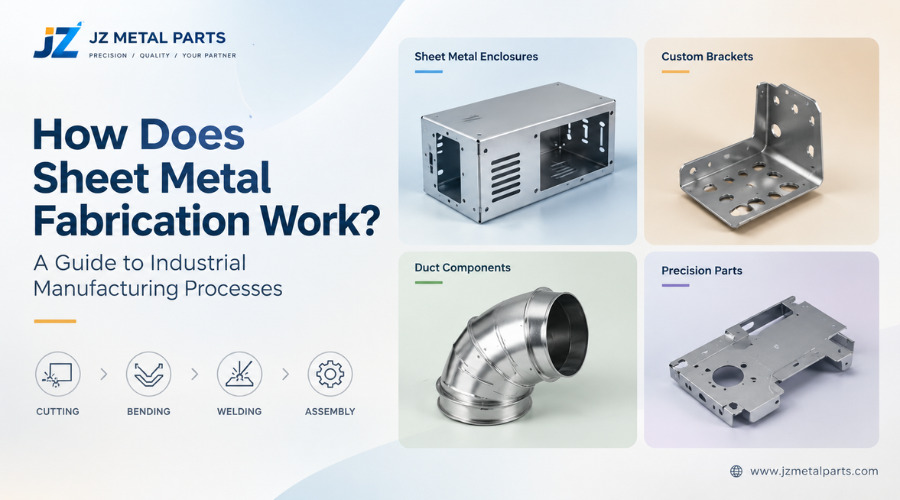
Every enclosure, bracket, panel, rib, and similar part needs a standard process of production. That method is an evergreen solution on which many giants like the automotive, aerospace, construction, and electronics industries rely. They need custom sheet metal fabrication China service for every advanced solution where a standard one can not comply. This method includes design and material selection, cutting, bending, punching, joining, and finishing processes. It is a lengthy process, but the results are symbolic. So, you need this detailed guide to get a deeper insight into how this method works and helps those industries.
It is a lengthy process, but way less complex than many other production types. Since metal fabrication parts usually have simple and highly compatible designs, their production method does not have to be very challenging. So, that is what you are about to learn in the steps below in the fabrication process.
The first and initial step is the design or geometric details of the part that you are about to manufacture. It has to be precise, perfect, and fully compatible. To meet these core requirements, engineers use 3D image software like CAD software from various companies and models. Some use simple software, and some use advanced ones. Since it is about meeting requirements like high functionality, efficiency, thickness, angle, and compatibility, everything is considered in this process. The design has to be cost-efficient and fully compatible for the desired purpose. Engineers develop the design and clear it for the next step.
You can learn more about how deep the drawing process goes regarding the precision level.
The second step in the sheet metal fabrication process is material selection. Now, the production team selects the material as per the requirement of design. There are different options in industry, and each material type has pros and cons. Usually, metal industries go for carbon steel, galvanized steel, stainless steel, aluminum, copper, brass, and titanium. Their performance, durability, compatibility, and cost differ from each other.
The selection has to be purely based on the application they are supposed to be used for. For instance, if the environment is non-corrosive or mildly corrosive, carbon steel or galvanized steel works well, respectively. If it is for a highly corrosive environment, stainless steel and titanium are suitable. However, titanium is highly costly compared to stainless steel. Likewise, copper, brass, and aluminum have different specifications to be compatible with specific conditions. Manufacturers have to choose each material as per the application type. For instance, here is how you can learn about the selection of an OEM aluminum enclosure supplier.
Now, the cutting process starts where the massive sheets are transformed into small parts. Some manufacturers use laser cutting machines, and some use plasma cutting machines. Some use a shearing machine for low-cost operations. Some use waterjet cutting machines depending on the budget and cutting quality. Large pieces are further cut into smaller sizes as per the requirements of the fabrication part. Once all the sheets are turned into small sheets of metal, they go for the next process.
This step turns those small metal sheets into desired shapes and angles. This is where manufacturers use rolling machines or press brakes to do that. These machines use hydraulic power to turn numerous small sheets into desired shapes. Each part goes into the bending machine to face tons of hydraulic pressure for the instant bending process. Back-to-back parts enter the machine to get the desired angular bending. Manufacturers bend each side’s sheet of the desired part they want.
After the above step, all the parts go through the punching machine. This process takes place to create holes in each part for the fasteners. Without the holes, all the bent parts can not be attached to the desired parts or machine. So, the punching process ensures they have holes or sections in the specific spots for the joining process. It is a rapid process where every part instantly goes into the machine, and the hydraulic press makes the hole precisely. All the parts get the required holes as per the specifications provided by the client. Here is a similar method: the metal stamping process, which you can learn about.
Then all the parts that have gone through the cutting, bending, and punching process are joined together. Either they are joined with punching machines or through the welding process. It all depends on the application type one has to follow.
In the welding process, some use MIG (Metal inert gas), and some use TIG (Tungsten inert gas) welding processes. After the welding process, all the parts have to go through one final step. That one final step is finishing.
Surface finishing ensures the parts have basic protection against corrosion and salt impacts. There are various kinds of finishes, which are anodizing, powder coating, electroplating, and paint. Some use single coats, and some use double coats. The finishing part is also important because it reduces the risk of corrosion and erosion. In applications where the parts have to face continuous moisture and chemical exposure, they specifically need protective coats.
Besides, finishing provides a paint job, which makes the appearance way better than before. It helps in branding through symbolic shades on machine parts. Automotive, machinery, electronics, and electrical applications need well-painted sheet metal fabricated parts.
Here is how you can learn which method is better for the finishing process: in-house or outsourcing.
Automotive, electronics, aerospace, machinery, and construction industries heavily rely on sheet metal fabrication. Their every project requires enclosures, frames, and lots of types of bent metal parts. They need a standard and sometimes a custom sheet metal fabrication process for that. As the world of robotics is expanding, these operations are becoming more advanced. EVs, robots, and various new machines need frames and enclosures that come through the same fabrication process. The only difference is the quality, and every new technology demands enclosed parts for electronic boards’ protection.
Sheet metal fabrication is a traditional and one of the most active methods used in the metal industry. Many industries need metal parts, especially enclosures that are made of bent metal sheets. This process is a versatile solution for industries like automotive, construction, electronics, aerospace, and the list goes on. Even the marine industry needs such parts that aid in massive operations in harsh conditions. Now that you know how this process takes place, the next thing you should know is who to choose for it. It should be none other than DongGuan JianZhao Metal Plastic Co., Ltd. It is a Chinese manufacturer that can provide standard and custom sheet metal fabrication services to all.
Yes, some do, and one of them is DongGuan JianZhao Metal Plastic Co., Ltd. This manufacturer has both standard and custom services for buyers from different industries. The prices and supportive services, along with overall quality, will be highly satisfactory. You can contact this manufacturer regarding specifications, samples, and quotations.
Yes, Chinese manufacturers are more budget-friendly than any global manufacturer. They work on excellent economies of scale, and it helps them dominate the industry. DongGuan JianZhao Metal Plastic Co., Ltd. is one of those Chinese manufacturers who can be highly beneficial for different industries.
It all depends on the overall costing process. You need to analyze the production and sourcing cost along with every secondary element. If you lack fixed assets like land and machinery, you can go for an outsourcing process. This method is cost-effective for standard and custom parts, unless there is a high need for confidentiality for your design and application. You can try DongGuan JianZhao Metal Plastic Co., Ltd. if you are planning to outsource sheet metal fabrication at low cost and high efficiency.
Highlights • The bracket's grade and coating
READ FULLSummary Every enclosure, bracket, panel, rib, and
READ FULLA vague RFQ produces a vague quote. If you send a
READ FULL

Have a question or need a quote? Fill out this form and our team will get back to you quickly!


