
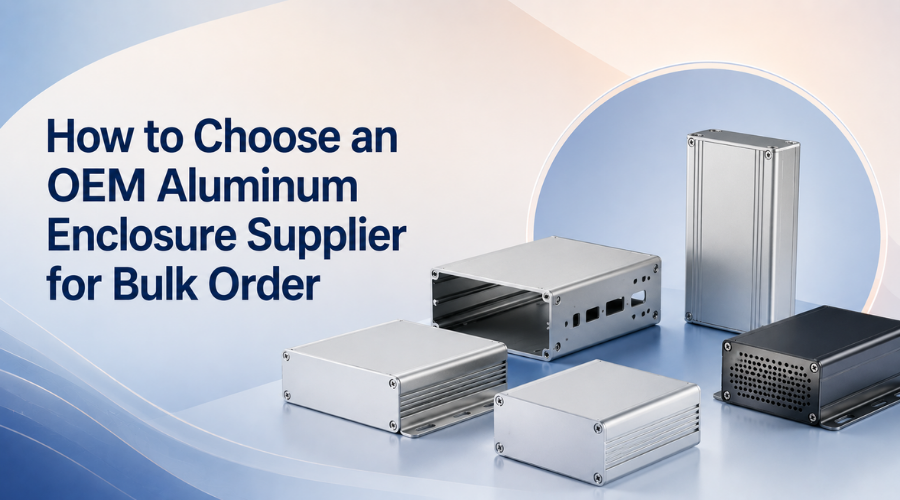
Aluminum enclosures protect electronics, control systems, and industrial equipment. It's possible to find yourself with fit problems, corrosion, or expensive delays if you don't select the right OEM aluminum enclosure supplier. This guide helps determine what to assess before ordering in bulk.
Aluminum enclosures protect sensitive parts like circuit boards and industrial controls. Varied manufacturing tolerances can lead to fit problems during assembly. Poor sealing can lead to moisture or dust ingress, which can adversely affect the internal electronics.
When a supplier compromises on material grade or smoothness, acceptable results may be obtained at first but will cause issues later. Certification is even more critical in regulated sectors like automotive, medical, and telecom, where the requirements add another supplier evaluation.
Common Alloy Choices
Aluminum enclosures are available in 5052, 6061, and 6063 alloys. Excellent corrosion resistance and good formability make 5052 alloy ideal for sheet metal enclosures. 6061 is a stronger alloy, preferred for extruded or machined enclosure designs. 6063 is used for extruded profiles that require smooth surface finishes, generally used for enclosures where surface finishes are visible.
Matching Alloy to Application
Talk to your OEM aluminum enclosure supplier about the alloy type that can be used for the application. Products used outdoors or in marine environments must use a highly resistant alloy. If it is to be used indoors, a cheaper alloy will suffice as long as the product is not sacrificed in terms of functionality.
Sheet Metal Fabrication
The sheet metal fabrication process cuts, bends, and welds flat aluminum sheets to create enclosures. The process is ideal for custom designs and lower- to mid-volume production runs. It is also a less expensive and more flexible alternative to die casting.
Extrusion
The extrusion process produces long aluminum profiles by forcing the material through a shaped die, then cutting it to size to make aluminum enclosure bodies. This process is ideal for enclosures with regular cross-sectional shapes such as cases and enclosures for racks or long instrument enclosures.
Die Casting
Die casting is a high-volume production method in which molten aluminum is poured into a mold containing detailed information to form complex parts. The initial capital outlay is higher because you must invest in tools, but this method can be profitable at large volumes.
Enclosure tolerances range from ±0.1mm to ±0.3mm, depending on part complexity and manufacturing process, and are typical for standard aluminum enclosures. Tighter tolerances, and sometimes as low as 0.05mm, are possible but will increase the cost and production lead time. Check with the supplier what regular tolerance they use for this enclosure design. Specifying tolerances higher than needed in real use makes them more costly, but not necessarily faster.
Anodizing
Anodizing forms an aluminum oxide layer on the aluminum surface, giving the surface corrosion resistance and a range of colors. Suitable for durable enclosures and retaining appearance, as is common with consumer goods and electronics, this finish is ideal.
Powder Coating
Powder coating is an electrostatic application process that yields a long-lasting colored coating after curing. It is a good choice for scratch resistance and color choice, and suitable for industrial equipment enclosures where the outside surface has to be strong.
Brushed and Mill Finished
Brushed finishes provide a clean and textured look without coating. Mill finish is the least expensive aluminum finish, but below the natural oxide layer, there is little additional corrosion protection.
Understanding IP Ratings
IP ratings are a measure of the enclosure's resistance to dust and moisture. Commonly used enclosure IP ratings are in the range of IP54 to IP67; IP67 is the most protective. Ensure the application requires the right rating before finalizing enclosure design specifications.
Gasket and Seal Materials
Inquire with your supplier regarding the gasket material of a sealed enclosure: silicone or neoprene. Over time, gasket quality can impact long-term sealing, particularly in areas that experience temperature fluctuations or extended outdoor application.
CNC Machining for Custom Features
Enclosures are initially formed, then cutouts and mounting holes and vent slots are added through the process of CNC machining. Ask your supplier about their CNC expertise and typical turnaround time for custom bulk orders.
Custom Branding and Labeling
You will find some buyers require custom printing with their enclosures, whether it is laser engraving, silk screening, or embossing logos. Ask which branding techniques your supplier provides and how they will affect your order's price and delivery.
The minimum amount per order varies greatly across manufacturing processes. Low MOQs of a few hundred are possible for sheet metal fabrication, as it does not require much specialized tooling. The average MOQ for die casting is usually a minimum of a few thousand pieces per order to justify the tooling investment.
If this is your first time using a new OEM aluminum enclosure supplier, consider placing trial orders before purchasing a full production run, as the supplier may charge a per-unit premium.
First Article Inspection
Ask for an initial inspection of the article before commencing with production. This validates initial sample enclosures against dimensional and finish requirements so that these problems can be corrected before the contract's whole order quantity is released.
In-Process and Final Inspection
Ask if parts are inspected as they go through their manufacturing or at delivery. Detecting dimensional drift, finish irregularities, or sealing problems early can prevent a full shipment from becoming a problem.
ISO 9001 Certification
ISO 9001 certification guarantees a documented QMS throughout the manufacturing process. This certification indicates good process control but should be supplemented with samples and inspection reports from buyers to confirm actual production quality.
Industry-Specific Certifications
Other certifications may be applicable, depending on the application. IATF 16949 may apply to automotive enclosures in specific cases. Additional regulatory documentation may be required for telecommunications or medical applications. Check what certifications are relevant to your product type.
Factory Audits
When making a large bulk order, ask for an on-site factory audit or the help of a third-party inspection service. This audit verifies production capacity and equipment status as stated by the supplier when discussing capacity.
Technical and Communication Responsiveness:
Review technical questions early in the negotiation process, such as tolerances and the availability of specific alloys. A supplier that provides specific, accurate answers is likely to have more focused production processes than a company that gives general assurances.
Export Experience
Ensure that the supplier is experienced in shipping to your country, and has an awareness of destination product certification requirements and customs documentation. An established export experience means fewer delays due to documentation issues.
Material Price Fluctuation
The price of aluminum commodities also changes from time to time, which will influence the quotation price. Ask whether the supplier offers a fixed contract price or if the price fluctuates with material market changes.
Shipping and Incoterms
Confirm the terms of the Incoterms (FOB, CIF or EXW, etc.). This determines who is liable for freight, insurance, and customs clearance charges. For new importers, clarify these terms early in the sourcing process.
Packaging for Safe International Shipping
Although normally robust, aluminum enclosures can be scratched or dented during shipping if not transported properly. Ask your supplier about their standard export packing, which may include protective film, foil dividers, heavy-duty export cartons for bulk packing, etc. If available, ask them for their own damage rate on international shipments. This shows a greater commitment to quality control from beginning to end.
Sometimes people complete the design without checking with the supplier whether the product can be made, leaving them to go back to the drawing board after tooling has already begun. Failing the first inspection meant throwing away entire production runs because dimensional or finish errors went undetected. Additionally, scheduling buffers can help prevent product release delays, which can occur if lead times for custom tooling are underestimated.
After finding a reliable OEM supplier of aluminum enclosures, its quality and communication are valuable if you require a repeated order. Engaging a supplier familiar with your specifications minimizes onboarding issues associated with subsequent production runs.
Review their supplier relationship from time to time because things change, including expansion of production capacity and changes in material costs. An annual review will ensure you remain on competitive terms as your order volume increases.
When choosing a supplier for OEM aluminum enclosures, it is important to take into consideration the alloy, manufacturing process, and quality control measures. Avoid bulk orders without prior factory audit, first article inspection, and documentation. This can help keep your production timeline within the process and ensure that your product is dependable.
Where do I purchase aluminum enclosures wholesale?
You can verify any reliable supplier through trade platforms or by contacting a known metal fabrication exporter directly.
How to select the correct supplier of aluminum enclosures?
Before placing a bulk order, ask for a factory audit report, first article inspection, and material certifications.
Where can I find custom aluminum enclosures for my company?
Work with an OEM aluminum enclosure supplier with excellent tooling terms, tolerances, and export experience.
What is the quantity you need to order to get the custom aluminum enclosures?
MOQs would depend on the manufacturing process; for sheet metal manufacturing, it would be a few hundred, and for die casting, several thousand.
Which IP rating should I use for an outdoor electronics enclosure?
Most outdoor applications use IP65 or higher, depending on exposure to dust, rain, or direct water contact.
Aluminum enclosures protect electronics, control systems, and industrial equipment. It's
READ FULLChina remains one of the largest suppliers of stamped metal products. Buyers should fami
READ FULLAluminum enclosures are the most basic foundation of almost every tech or electric devic
READ FULL

Have a question or need a quote? Fill out this form and our team will get back to you quickly!


