
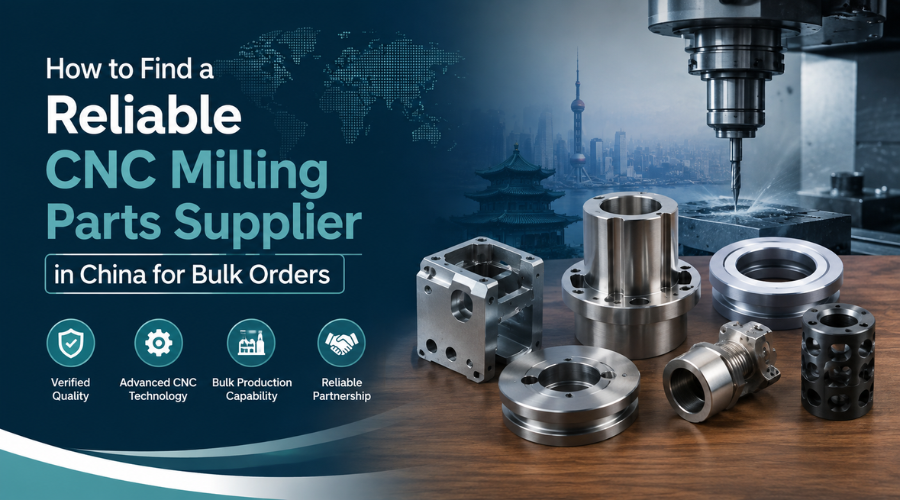
The impact of one bad supplier decision can be enormous. It can stop an entire OEM production line and result in missed delivery windows. That domino effect continues and parts fail incoming inspection, resulting in a factory contact who goes silent right when your launch date is locked in.
You already know this, and being in the sector, you must have experienced this firsthand.
China remains the world's deepest pool of precision-machined parts suppliers, and the cost case for sourcing there is still strong.
But the gap between a capable factory and a polished middleman is wide, and spotting the difference takes more than a quick Alibaba search. This guide gives you a field-tested framework for finding a CNC milling parts supplier you can actually build a production schedule around. The same framework seasoned procurement teams use before they commit a single dollar.
Let's walk through it step by step.
The numbers are hard to ignore. Machining costs in China typically run 30 to 50% below domestic rates in North America and Western Europe. Labor is part of that story, but not all of it. China's manufacturing infrastructure is also unrivaled. Material procurement, tooling, and overhead all cost less, and dense industrial clusters in Guangdong, Jiangsu, and Zhejiang create fierce local competition that keeps pricing honest.
Capacity matters just as much. A mid-sized shop in Dongguan or Suzhou can scale from a 200-piece pilot to a 20,000-piece production run pretty effortlessly and at an amazing turnaround rate. Finding that kind of flexibility domestically, at that price, is rare.
Your competitors already know this fact. Many of them have spent the last two years locking in capacity with top-tier Chinese shops. This means you have to move fast because the best factories are overbooked and are getting pickier about who they work with. Waiting costs you leverage.
But a word of caution before you start sending RFQs. A 40% saving means nothing if half your bulk CNC milled components fail dimensional inspection on arrival. Cheap and fast is easy to find in China. Cheap, fast, and reliable takes real vetting work. That is what we shall focus on from this point onwards.
Most buyers make their first mistake before they contact anyone. They send a vague RFQ, get 40 quotes back, and wonder why the prices vary by 300%.
Vagueness attracts the wrong suppliers. Serious factories, the ones with real quality systems, often ignore incomplete inquiries entirely. Your sloppy RFQ just filtered out your best candidates.
Before you reach out to a single CNC milling parts supplier, prepare a complete technical package. That includes the following:
2D drawings and 3D files in STEP or IGES format, fully dimensioned and revision-controlled
Tolerance callouts, whether ISO 2768 medium/fine or tighter specs on critical features
Material specifications with required certifications. No vague terms like "aluminum" but specific ones like "6061-T6 with mill certs"
Surface finish requirements, including roughness values and any coating or anodizing specs
Annual volume estimates and target pricing, so factories can quote production rates rather than prototype rates
Inspection requirements, such as full dimensional reports or sampling plans
That last point deserves emphasis. Factories quote very differently for a one-off job versus a recurring annual program. If you want production pricing, show them that you are looking for a long-term relationship.
At this stage, you should aim for 8 to 12 candidates to make it to your list. Here is where experienced sourcing teams actually look.
B2B platforms. Alibaba, Made-in-China, and Tradewheel remain the biggest pools. Use them wisely. On Alibaba, filter for Trade Assurance and Verified Supplier status, then dig into how long the company has held its membership. A ten-year verified account tells you more than a glossy storefront ever will.
Trade shows. CIMT (China International Machine Tool Show) and the Canton Fair let you meet factory reps face to face. These shows will take more budget and planning, but one honest conversation across a booth table reveals things six months of emails cannot.
Sourcing agents. A good agent earns their fee by bridging language gaps and pre-filtering factories. A bad one adds a hidden 15% markup and steers you toward whoever pays them kickbacks. If you use an agent, be careful and ask exactly how they earn their commissions.
Referrals and industry networks. This is the most underused channel in CNC machining sourcing, and many startup and seasoned suppliers neglect this channel. But it is often the most reliable. Ask peers at trade associations, LinkedIn groups, or your existing component suppliers. A warm introduction to a proven factory is better than a cold platform search.
One practical note. Spread the list of suppliers found across at least two channels. If every candidate came from the same platform search, you have tested one filter, not the market.
Now comes the part where most buyers get fooled. Trading companies present themselves beautifully. Professional English, fast replies, and polished websites. Real factories are often rougher and may not have glossy and stylish websites. Do not confuse presentation with capability.
Trading companies are not all bad. Some add genuine value in logistics and communication. But signing up with them is taking a major risk. The real danger is paying factory-direct prices for a marked-up service, or worse, having no idea which workshop actually machines your parts. You must know who you are paying.
Request the business license. Check the registered capital and, more importantly, the business scope. It should say "manufacturing" or "machining," not just "trading" or "import/export."
Ask for a live video factory tour. Not a pre-recorded marketing video. Live. Ask the person to walk the shop floor and watch the machine nameplates as they pass. A real shop will do this gladly. A broker will make excuses.
Demand a detailed equipment list. How many machining centers? 3-axis or 5-axis? Inquire about the machinery brands they have, whether DMG Mori, Haas, Mazak, or domestic brands. Then cross-check. A factory claiming forty machines should show forty machines on the tour.
Check the address. An office in a Shenzhen commercial tower is not a factory. Ask where production physically happens, then verify with satellite maps or a third-party inspection service.
Two or three days of verification work here can save you two quarters of production chaos later.
A factory can own beautiful machines and still ship you a trash item. Equipment is only half the equation. The other half is linked to the quality system and protocols the manufacturer follows as part of their production process.
Start with certifications, and match them to your industry. ISO 9001 is the baseline; treat it as table stakes, not a differentiator. If you supply automotive, look for IATF 16949. Medical device work demands ISO 13485. Aerospace programs require AS9100. A factory holding a demanding sector certification has already survived audits far tougher than yours.
CMM (coordinate measuring machine) availability, brand, and calibration records
Height gauges, micrometers, and pin gauges for routine dimensional checks
Surface roughness testers if your prints call out finish values
Material verification tools, such as spectrometers for alloy confirmation
Here is the test that separates real operations from those that look good on paper. Ask for a sample dimensional inspection report from a recent production job. If it is a FAIR or PPAP document, then that is better. A capable factory will mail those documents within a day. A supplier who cannot produce a real CMM report or sends you something obviously templated just showed you exactly who they are. A non-genuine supplier.
Every reliable supplier relationship in China passes through the same gate: physical proof.
Order samples first. Understand what a sample actually proves, though. It proves the factory can hold your tolerances on their best day, with their best machinist, under full attention. It does not prove they can hold those tolerances across ten thousand parts in week six of production.
That is what the pilot batch is for. Before scaling to full bulk CNC-milled component volumes, run a pilot of 50 to 200 pieces. Treat it as a dress rehearsal for your production program:
Inspect every critical dimension, not a spot check. You want the full distribution, not a pass/fail snapshot.
Calculate Cpk on your tightest features. A Cpk of 1.33 or higher tells you the process is stable. Anything below 1.0 is a warning, no matter how good the samples looked.
Test communication under pressure. Raise a minor issue during the pilot and watch how the factory responds. Their behavior on a 100-piece order predicts their behavior on a 100,000-piece crisis.
You will be tempted to skip this step. The samples looked great, your timeline is tight, and the pilot costs two weeks and a few thousand dollars. If you go forward and skip it anyway, you risk discovering the process is unstable after your deposit funded a full production run of scrap. Two weeks now, or two quarters of recovery later. Your choice.
Experience teaches you to read the warning signs early. Here are the ones that should trigger immediate caution, no matter how attractive the quote looks:
Pricing 30 percent below every other quote. Someone is cutting a corner you cannot see yet. Material substitution, skipped inspection, and unquoted finishing costs. The bill always arrives.
Reluctance to share a business license or factory photos. Legitimate factories hand these over without hesitation. Stalling means something is being hidden.
Slow or vague answers to technical questions. If they cannot discuss your tolerance callouts intelligently during the sales process, they will not manage them during production.
Constant pressure to pay fast. A supplier pushing for full upfront payment, or rushing you past due diligence, is telling you their priority. It is not your parts.
Refusing a live video tour. In 2025, every serious factory has a smartphone on the floor. No exceptions.
One red flag might have an innocent explanation. Two red flags is a pattern. Three, and you walk away, because your competitors' failed orders are filled with buyers who ignored flag number three.
Finding a reliable CNC milling parts supplier in China is not a search problem. It is a verification problem. The framework we outlined in this blog is simple, but it needs to be implemented without skipping steps. None of these steps is expensive. All of them are cheaper than one failed production run.
The buyers who get burned in China are rarely unlucky. They are rushed. Do the work upfront, and China's machining capacity becomes exactly what it should be for your program: a durable competitive advantage.
Ready to start your supplier search? Download our free Supplier Vetting Checklist, or contact our team for a quote on your next bulk machining program.
Aluminum enclosures protect electronics, control systems, and industrial equipment. It's
READ FULLChina remains one of the largest suppliers of stamped metal products. Buyers should fami
READ FULLAluminum enclosures are the most basic foundation of almost every tech or electric devic
READ FULL

Have a question or need a quote? Fill out this form and our team will get back to you quickly!


