
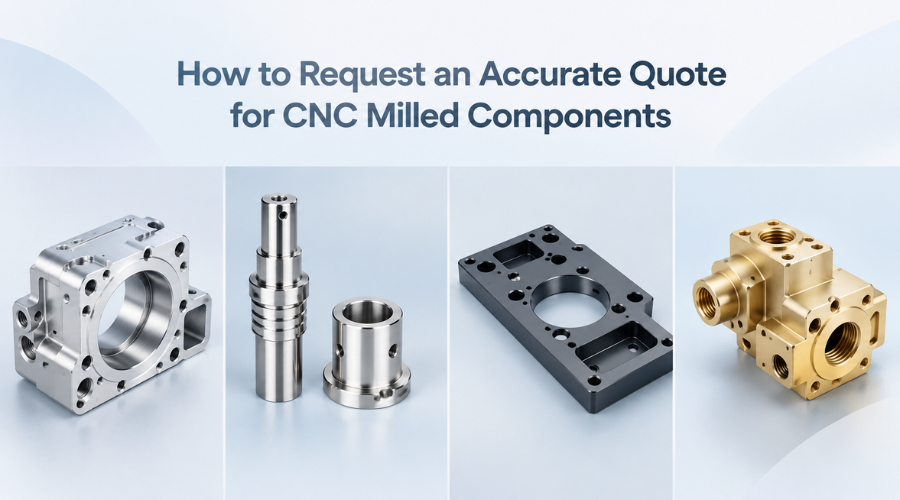
A vague RFQ produces a vague quote. If you send a CNC Milling Parts supplier only a 3D model and ask for the “best price,” you are leaving too much open to interpretation. The supplier may not know which dimensions are important or what material grade you require. They may not know if surface finishing is included, or how many parts you actually need.
This vagueness creates a problem when you start comparing quotations. One supplier may assume standard tolerances, another may price tighter tolerances, and a third may exclude finishing or inspection costs altogether. The numbers will look comparable, but they are not.
So, if you want an accurate CNC milling quote, give suppliers enough information to price the same manufacturing scope.
Here is how to structure your RFQ.
Your technical drawing is the foundation of the quotation.
A 3D CAD model shows the geometry, but it may not communicate every manufacturing requirement. Your supplier needs to know which dimensions control the part's function and which requirements are non-negotiable.
Vital dimensions to include are dimensional tolerances, geometric tolerances, hole sizes and locations. Where applicable also include thread specifications, radii, chamfers, datum references.
One small but important detail to make sure is that the drawing should have a clear revision number. If you later modify a dimension, the supplier should be able to identify exactly which drawing version was used for the quotation.
Whenever possible, provide both a 2D engineering drawing and a 3D CAD model. Common formats include STEP, IGES, and Parasolid, depending on your supplier's manufacturing software.
The 3D model helps the supplier evaluate the component's geometry and machining requirements. The 2D drawing establishes the controlled dimensions and tolerances.
Sending both files gives your CNC Milling Parts supplier a much clearer basis for calculating machining time and tooling requirements
Material is one of the first things a supplier needs to establish before calculating the manufacturing cost.
Saying you need an “aluminum part” may not be enough. Different aluminum grades can have different material prices, machining characteristics, and mechanical properties.
State the exact material grade or applicable material specification whenever your design requires one.
This information should be adapted to the metal or alloy. And if your application requires specific mechanical properties, make that clear in the RFQ. Another important thing to state clearly is the need for material certification or traceability documentation.
That is because material cost is only one part of the equation. The material specification can also affect tool selection, quality control and lead time.
A supplier cannot price a prototype and a production run in exactly the same way.
Setup, programming, tooling, inspection, and material purchasing all these change as the order quantity becomes larger. So, if you want accurate pricing, give your supplier a realistic view of your demand.
State the prototype quantity, initial production quantity, expected batch size, and annual volume if you have that information.
For example, you might request pricing for 10, 100, 500, and 1,000 pieces. If you expect repeat orders, mention that as well. A supplier evaluating a long-term production opportunity may approach capacity planning and pricing differently from a supplier quoting a one-off prototype.
This is particularly important when sourcing wholesale CNC Milling Parts. Your CNC parts supplier needs to understand whether you are purchasing a small batch today or building toward recurring production.
Tolerance requirements can have a direct effect on machining cost. A component with very tight tolerances requires additional machining operations, more careful process control, and specialized tooling. But that does not mean every dimension should automatically receive an extremely tight tolerance.
Identify the dimensions that are genuinely critical to the component's function and for those dimensions specify the required tolerances clearly.
That helps your parts manufacturer from making wrong assumptions. But more than that it prevents you from paying more for precision manufacture that is not really needed.
Surface finish needs the same attention to detail.
If you require a particular roughness value, state it. If the component needs a particular surface finishing operation like anodizing, plating, or polishing, or another treatment, mention that requirement in the RFQ.
Lastly, do not assume finishing is automatically included in the machining price. That is why your RFQ should clearly separate the machining requirement from any post-machining treatment. Otherwise, a quotation that initially appears cheaper may become more expensive once finishing is added.
Quality is a non-negotiable in CNC parts orders so quality requirements should be defined before you ask for a final quotation.
In many industries quality regulations are particularly strict so you should state clearly that you need inspection reports, material certificates, a Certificate of Conformance, First Article Inspection, CMM inspection, or specific sampling procedures etc.
Identify the inspection requirements that are mandatory for your parts order rather than leaving them to be discussed after production.
You should also identify critical dimensions or characteristics that require particular attention. It also gives you a clearer basis for comparing suppliers. If Supplier A includes a detailed inspection package while Supplier B quotes machining only, their unit prices should not be treated as equivalent.
The CNC machining price is not necessarily your final procurement cost. You also need to consider how the parts will be packaged, shipped, and delivered.
State your delivery destination, required delivery date, packaging expectations, and preferred shipping arrangements.
If individual packaging is required to protect machined surfaces, specify it. If export packaging is necessary, say so.
And when you are sourcing internationally, make sure the quotation clearly identifies the applicable shipping or delivery terms.
Separate Unit Price From Total Cost
So, ask your supplier to separate the major cost elements where possible.
Part price. Tooling or setup. Surface finishing. Inspection. Packaging. Shipping.
That makes the quotation much easier to analyze.
A supplier offering a higher unit price may still provide the lower total procurement cost if its quotation includes services that another supplier has excluded.
Once the technical scope is clear, you need to make the commercial side equally specific.
Do not simply ask, “What is your price?”
Instead, ask the supplier to confirm the complete commercial scope.
Confirm the unit price, tooling or setup charges, MOQ, production lead time, material sourcing, inspection capabilities, certifications, payment terms, quote validity, and any additional charges.
For example, one supplier may include surface treatment while another excludes it. One may include inspection documentation while another charges separately. One may price delivery while another quotes the parts at the factory gate.
That is why understanding exclusions can be just as important as understanding the quoted price.
This is where many procurement teams make a costly mistake. They collect three quotations, identify the lowest unit price, and move forward. But a unit price only tells you part of the story. For accurate costing, compare suppliers against these five metrics: technical expertise, quality, commercial, and delivery requirements.
A template for parts supplier comparison is given below.
|
Factor |
Supplier A |
Supplier B |
Supplier C |
|
Unit price |
|||
|
Tooling/setup |
|||
|
MOQ |
|||
|
Lead time |
|||
|
Material |
|||
|
Finishing |
|||
|
Inspection |
|||
|
Shipping |
|||
|
Certifications |
|||
|
Payment terms |
An accurate CNC milling quote starts with an accurate RFQ. The more clearly you define the order details the less room suppliers have to make different assumptions.
For buyers working with a CNC Milling Parts supplier, a clear RFQ submission improves means you get quotes that are accurate and comparable. Moreover, when you are sourcing wholesale CNC Milling Parts, a structured RFQ becomes even more valuable because small differences in unit pricing, setup costs, lead times, and quality requirements can materially affect your total procurement cost.
Highlights • The bracket's grade and coating
READ FULLSummary Every enclosure, bracket, panel, rib, and
READ FULLA vague RFQ produces a vague quote. If you send a
READ FULL

Have a question or need a quote? Fill out this form and our team will get back to you quickly!


